
The Heart Brain Connection: Supporting Love, Gratitude, and Emotional Well Being With HeartMath®
Written by Brenda Belohoubek, LPC, NCC, CAIP, CMIP, CTP, February 2026
Often, people come into therapy feeling stretched thin or overwhelmed. They describe racing thoughts, tight chests, trouble sleeping, or a sense that their emotions are running ahead of them. Even when life looks “fine” from the outside, the body often tells a different story. Stress can manifest as headaches, irritability, fatigue, or a feeling of being disconnected from yourself or others.
In the current global and political climate, these experiences are becoming even more common. Many people are carrying a quiet heaviness, a sense of uncertainty, or a feeling that the world is moving faster than their nervous system can keep up with. If any of this feels familiar, you are not alone. And you are not doing anything wrong. Our bodies are designed to respond to stress, and they are doing their best to navigate a complex moment.
This is one reason the heart-brain connection matters. The heart plays a powerful role in emotional regulation, clarity, and resilience. HeartMath® is a research-based approach that teaches simple techniques to support this connection and help the nervous system shift into a more balanced state. These practices are accessible, gentle, and easy to integrate into daily life, especially when the world around us feels anything but calm.
Many people are familiar with mindfulness or deep breathing exercises, and HeartMath® may sound similar at first. What makes HeartMath® distinct is its focus on the heart’s role in emotional regulation. Heart Focused Breathing™ is not simply slow breathing. It is a specific technique that shifts attention to the area of the heart to support heart-brain communication and help the nervous system move into a more coherent state. This heart-centered focus is what makes it the foundational HeartMath® technique and the starting point for all other HeartMath® practices.
My own introduction to HeartMath® began in high school during a time when I was experiencing debilitating stress-induced migraines. Despite countless medical appointments and specialized treatments, nothing seemed to help. When I learned the HeartMath® technique of Heart Focused Breathing™, I discovered a simple and accessible way to regulate my nervous system and shift my internal stress response. Heart Focused Breathing™ is the foundational HeartMath® technique, and over time, it helped reduce the migraines that had taken over my life and gave me a sense of agency I had never felt before.
As the years went on, I continued using these tools in everyday life. What I did not realize at the time was how deeply they were preparing my nervous system to respond to moments of intense stress. This became especially clear to me in my twenties, when I was involved in a serious auto accident in which my passenger and I sustained significant injuries. In the midst of the chaos, my body instinctively shifted into the Heart Focused Breathing™ pattern I had practiced for years. I knew I needed to remain as calm and clear as possible, and my system recognized the warning signs. It kept me conscious and regulated long enough to call emergency personnel, communicate with first responders, and advocate for the medical support we each needed. Several members of the police and medical team later shared how surprised they were by how steady I remained. My body did eventually go into shock, but not until we were safely in the care of medical personnel. That experience shaped my understanding of just how powerful the heart-brain connection can be, inspiring me to seek further training.
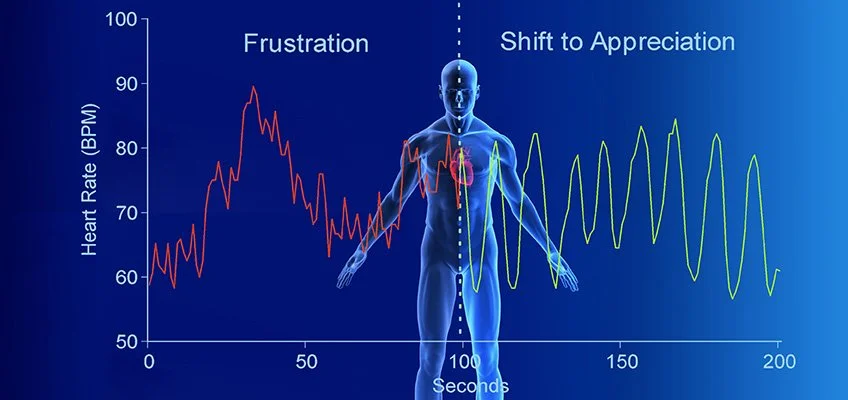
Today, as a HeartMath® provider, practitioner, and trainer, I share these tools because they support emotional balance, clearer thinking, and a greater capacity to meet life’s challenges with steadiness and compassion. Research from the HeartMath® Institute shows that the heart and brain are in constant communication, and that the heart sends more signals to the brain than the brain sends to the heart. When we shift into a coherent state, the nervous system becomes more organized, cortisol levels decrease, and we experience greater clarity and emotional regulation.
A Simple HeartMath® Practice
Let’s try a little Heart Focused Breathing™ now: “Focus your attention in the area of your heart. Imagine your breath is flowing in and out of your heart or chest area, breathing a little slower and deeper than usual, finding a rhythm that is easy and comfortable.” Even a few slow breaths can create a noticeable shift.
Why This Matters for Mental Health
HeartMath’s Global Coherence Initiative® explores how individual coherence contributes to collective well-being. When we cultivate love, gratitude, and compassion within ourselves, we support not only our own emotional health but also the health of our relationships and communities. In times when the world feels divided or uncertain, these qualities become even more essential.
Whether you are navigating stress, caring for others, or simply seeking moments of calm, your emotional state matters. Your heart matters. And tending to your inner world is not selfish. It is a meaningful contribution to the collective environment we all share.
As we move through this month dedicated to love and heart health, I invite you to take a moment to reconnect with your own heart. Heart Focused Breathing™ is one simple way to begin. Whether you choose this practice or another that feels meaningful to you, tending to your heart is an act of care for yourself, your loved ones, and for the world you move through each day.
