
Managing ADHD: Accentuate the Positive, Eliminate the Negative!
Written by Maria Palamara, LPC, NCC, CCC, May 2026
What is ADHD?

ADHD (Attention Deficit Hyperactivity Disorder) is a common neurodevelopmental disorder that affects the brain's ability to regulate focus, impulses, and energy, causing persistent patterns of inattention, hyperactivity, and/or impulsivity that interfere with daily functioning at school, work, or in relationships. You may have heard it referred to as ADD.
(1) It typically appears in childhood, and some symptoms may not become problematic until later in life. It is often not noticed in childhood –- especially in girls and others with the primarily inattentive type vs the hyperactive type. These overlooked people are typically not behavior problems in their school years and may be able to “mask” their symptoms, especially if they are intelligent and interested in many topics. The CDC estimates that approximately 3.5% to 11.4% of people have ADHD.
(2) While ADHD comes with its challenges, it also is considered by some people to be a “superpower” in terms of creativity and ability to “hyper-focus” on things that are interesting. Many successful entrepreneurs have ADHD, and they attribute their success to the creative problem solving and innovative, “out of the box” thinking that they have learned to use to navigate some of the challenges associated with ADHD.
(3) Stimulant medication is typically considered the first line of treatment for ADHD, but it is not appropriate for everyone, and some people would prefer to avoid medication. This article outlines some non-medication approaches that can be applied whether someone is taking medication for ADHD or not. In addition to the suggestions below, working with an ADHD coach or a therapist who is experienced in treating individuals with ADHD can be helpful.
Manage your time:
Often people with ADHD experience time differently — sometimes it can feel like there are only two times: “now” and “not now,” especially if caught up in a hyper-focus situation. This can result in missing or being late for important meetings or appointments.
Use a calendar for all your appointments and activities, even those that are just for you (like time to exercise). Many Some people find paper calendars helpful, but others like using electronic calendars. Decide what works best for you and keep it updated every day.
If you use an electronic calendar like a smartphone or tablet, set alerts for each appointment that will give you enough time to make an appointment. So, if your doctor’s appointment is at 1PM and it takes 30 minutes to get there, set your alert for 12:15 which gives you 15 minutes to get ready and 30 minutes to get there.
Use visual timers to keep track of time, like reminding you to take a break every 30 minutes. It’s best to use something other than your cell phone timer which can be a distraction. You can learn about the “Pomodoro” technique for time management in the reference provided below (4).
Take care of your mind and body:
Here’s a new vocabulary word – interoception (5). It is the brain's ability to notice and initiate actionse based on signals from inside the body. It covers sensations like hunger, thirst, heartbeat, temperature, and muscle tension, and plays a crucial role in emotional regulation and self-awareness. People with ADHD sometimes have difficulty sensing these feelings until they become overwhelming, and as a result can ignore important signals like hunger which can affect mood and irritability.
Aim for regular meals and snacks that include protein, fruits, vegetables, and whole foods when possible. This can help support energy, mood, and focus throughout the day. Berries are a great snack.
Be sure to drink enough water every day. A good rule of thumb is to consume roughly half an ounce to one ounce of water per pound of body weight daily, so if you weigh 120lbs., you should try to drink at least 2 quarts of water daily, even more so in warm weather, if you’ve exercised a lot, or are taking medication.
Exercise regularly, even 15 minutes daily will be helpful, but ideally target 150 minutes per week. Even small amounts of exercise, as little as 25 minutes per week, show brain boosting benefits compared to no exercise at all. Make sure it is something that you like to do or you will avoid doing it.
Go outdoors for a little while every day – the sun is nature’s way of giving us energy and even vitamins (like Vitamin D!).
Take short breaks every half hour or so and make sure you get up and move.
Use meditation and mindfulness exercises to help get out of your head and increase your awareness of your body – breathing exercises like box breathing; focusing on your five senses; using a guided body-scan meditation to increase awareness of where you are holding stress in your body.
Develop good sleep habits – get to bed the same time every night and try to get 7-8 hours of sleep. Avoid napping, doing work or watching TV in your bed, and drinking sugary or caffeinated drinks after noon.
Get organized:
Often people with ADHD often people with ADHD struggle with misplacing everyday items like their wallet, keys, cell phone, sunglasses, or important papers. Being more organized to avoid this will make life less stressful. It can also be challenging to remember what you want to get done in a day until it’s too late.
Get rid of clutter that you don’t need in your work area.
Make a place for important things and papers that you can remember and that is relevant – for example, have a key holder near your exit door where you always put your keys, and keep your keys in the same place (your purse or jacket pocket) when you are away from home. Create a memory phrase like “keys, wallet, glasses, phone” for when you are away, so you don’t forget anything when you leave a place you’re visiting.
Plan your day with a to-do list, either just before you go to bed at night or first thing when you wake up. Be sure to prioritize it so that you don’t forget important tasks if you run out of time.
Don’t put too much on your to do list, or you may be disappointed if you don’t complete it. You can always do more tasks when you complete what you most need to get done.
For bigger projects or activities, break them up into smaller tasks and keep track of those. That will help give you a sense of accomplishment and also make the bigger project less scary. Work backwards from the due date to create a plan for completing the project on time.
Avoid distractions:
Focusing is one of the biggest issues that people who have ADHD face, despite also having an amazing ability to “hyper-focus” on something that they’re very interested in, like a clever spreadsheet, video games, or anything that feels especially engaging, urgent, rewarding, or stimulating. When hyper-focused, people can lose their sense of time and also not hear important information from people around them, so it is also something to be aware of.
Do your work away from distracting technology like the TV or your cell phone. Go to a different room where there are fewer distractions. Make sure you are comfortable and able to keep a good posture while you are working.
Put on soft background music or white noise – like a mix of classical music for studying, or light jazz. Avoid listening to music with lyrics and vocals as that might cause distraction while you are trying to focus.
Use a squeeze ball or other silent fidget toy while you are working to keep your body engaged while your mind works.
Use technology as a brain helper – not as something to avoid doing what you need to do.
Ask people to say your name to get your attention if it looks like you didn’t hear them the first time. That could help break through those hyper-focus moments without people thinking you are ignoring them.
Learn strategies to help remember important information:
Working memory, or the ability to remember important near-term things, can be challenging for people who have ADHD, especially when they feel overwhelmed by lots of information. Working memory is an important brain function that acts as a temporary "mental scratchpad," allowing you to hold and work with information over short periods, usually seconds. It is essential for reasoning, comprehension, learning, and updating information, such as remembering a phone number while typing it or solving multi-step math problems. (6)
Keep lists of what you need to remember on paper (preferably in a bound notebook or journal to prevent losing it) or on an electronic document or spreadsheet that you can work on from anywhere you might be.
Take the time to write things down if someone gives you more than two or three instructions at the same time, as you may forget the first one by the time you hear the third or fourth item in the list
Use memory tricks that work for you – try to create patterns that make the information relevant or more memorable, take brief notes that summarize a chapter’s important points to help you understand what you’ve read, and use a highlighter if allowed.
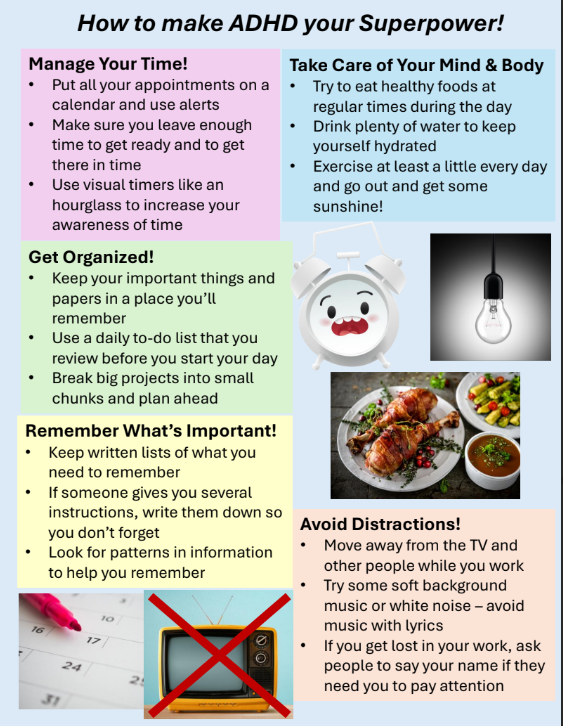
Informational Flyer for Child Population — ADHD
References:
What is ADHD? https://www.psychiatry.org/patients-families/adhd/what-is-adhd
Data and Statistics on ADHD: https://www.cdc.gov/adhd/data/index.html
Famous People with ADHD: https://www.additudemag.com/slideshows/famous-people-with-adhd/
Pomodoro Technique: https://success.oregonstate.edu/planning-time/pomodoro
Interoception: https://my.clevelandclinic.org/health/articles/interoception
Strategies for Improving Working Memory: https://ctl.stanford.edu/students/strategies-improving-working-memory
