
Grounding: An Essential Ingredient for Mental Health
Written by Julie Phelan, PhD, LPC, NCC, April 2026
There is no one perfect recipe for therapy – what works well for one person may backfire for the next. That is part of what makes being a therapist so interesting! But there is one ingredient that I have increasingly found to be essential for healing and growth no matter who walks through my office door or why, and it’s grounding.
Grounding refers to centering your ‘self’ (or awareness) in your body in the present moment. It means being fully in the “here and now” of one’s current environment and aware of one’s sensory and somatic (bodily) experience. Grounding techniques are the strategies we use to get ourselves back to that “fully present” place when we discover our mind has wandered off elsewhere (e.g., into a thought loop, worries about the future, or memories of the past) and/or that our emotions are running the show.
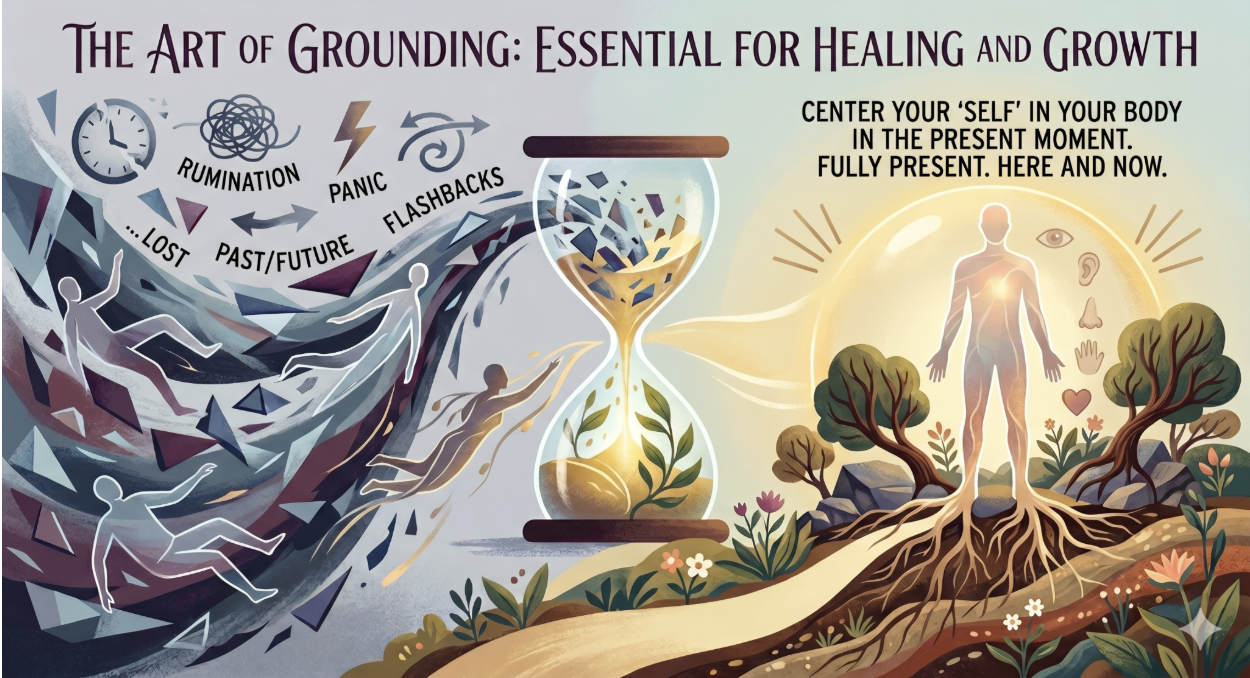
AI Generated Image
It may seem simple, but the ability to notice when your attention is no longer in the present and take action to bring it back is important. It’s pretty key to mental well-being in general (life tends to happen in the present moment, after all) as well as an essential first step to disrupting a whole host of distressing symptoms including ruminating thoughts, flashbacks, catastrophizing, dissociation, obsessions and compulsions, addictive urges, panic attacks, and emotional outbursts, to name a few. Conveniently, grounding is also a skill you can develop and strengthen on your own. All it takes is some experimentation to find the strategies that work best for your nervous system, and some practice and repetition using them.
Whether you are struggling with a mental health issue or are just the usual amount of overwhelmed at the state of the world, finding ways to pull yourself out of distressing thoughts, feelings, or memories helps to give you back some agency. It reintroduces that pause between stimulus and response that makes us human and allows us to choose how we respond rather than just reacting automatically. So if you do one thing for yourself this Mental Health Awareness month, maybe check out the list below, and find some ways to get yourself grounded.
Grounding Techniques List
There are about eight million grounding techniques out there - these are some of the ones that my clients and I have found most useful. That doesn't mean all of them will work for you. Experiment and see what helps and don’t forget you can stack techniques - sing in a hot shower! laugh while you dance! move while you call a friend!
Laugh!: Watch funny TikToks, YouTube clips, TV shows, etc., or (better yet) call up a funny friend. Laughter is by far the most effective way for many people to get out of their head and back into their bodies. But it has to be real laughter - not just a bemused smile as the next video autoplays in an endless loop on your phone.
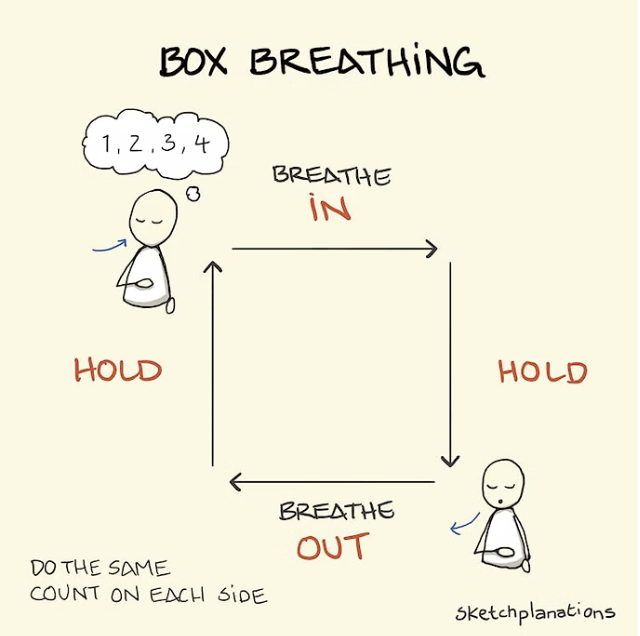
Breathing: There is a reason breathing is mentioned on every list of grounding strategies you can find. Breathing is the most direct way tointervene with the autonomic nervous system and facilitate a change in nervous system state. If you’re over-activated (e.g., anxious), try breathing exercises that extend the exhale (e.g., 4-7-8 breathing: inhale for 4, hold for 7, exhale for 8). If you’re flat or frozen, instead try extending the inhale. When in doubt, box breathing (inhale for 4, hold for 4, exhale for 4, hold for 4, repeat) gives you a balance.
Change your temperature: There are a variety of ways to do this - play around and find something that works for you. Grab an ice cube, splash your face with cold water, hold an ice pack to the back of your neck, take a hot bath, or drink a warm beverage. Our body tends to take notice when there's an abrupt temperature shift, and that can help you to snap out of your head and get you back on the ground. If you really want your nervous system to take notice (and you have no underlying health issues), hold your breath and submerge your face in cold water. This triggers the "diving reflex" which, among other things, will greatly slow your heart rate.
Move your body, change the scenery: Going for a short walk, especially outside, can help to shift things enough to pop you out of your head. This can be a good place to start to build up your tolerance for staying present. See how long you can stay in the moment, see if you can notice when you go back into your head, see if you can gently bring your attention back to the present. Don’t overdo it, and don’t expect miracles. Even small progress here can make a big difference and remember that noticing how hard it is for you to be mindful is in fact a key part of mastering mindfulness.
Dance or sing: Especially if you're trying to snap out of dissociation, depression, or any other low-energy state. We typically only dance and sing when we're feeling safe, so doing these can provide a powerful cue to your nervous system to reset.

Gentle movement: If singing and dancing seem too extreme, try gentle movement instead. Trauma, fear, even depression to some extent, teaches us to be small, still, and quiet - to not take up space… to not breathe. You can counteract that message by first engaging in bilateral movement (swaying side to side) and then getting big (stretching your arms up). Moving helps tell our brain it’s safe to take up space again. Gently turning your head from side to side and scanning out to the (even imagined) horizon likewise indicates safety and a shift away from danger’s call to only focus on what’s directly in front of us.
Other safety cues: Is there a smell or a taste you love? A candle or perfume that reminds you of a (safe) loved one, or a beverage you associate with happy times? Does the pressure of a weighted blanket or pillow help to calm you? Finding peace and calm inyour body is often an important first step in getting (and staying) grounded.
Talk to a loved one or trusted friend: Talking to someone you trust is helpful for a variety of reasons, and it doesn't even have to be about what's going on. We are social creatures, and our nervous systems are designed to be regulated by others, so being around someone calm works wonders when we’re dysregulated. Face to face is best. Pets can help too!
Sensory disruption: Ice cube, loud music, essential oil, sour candy, textured surface. You pick. The goal is to make your senses take notice! When the brain receives strong input from our external (exteroceptive) senses, it becomes much harder to stay completely in one’s head.
Feet on the ground: Taking it back to basics here - place both feet on the floor and press down gently, alternating feet. Can you feel your thigh or calf muscles activating? Can you feel the support of the ground beneath you? Barefoot and bare earth is best.
Make a list / empty the brain: If you're struggling to stay grounded because of stress or too many thoughts swirling in your head, making lists or journaling everything you're thinking can be really helpful. For the latter, try setting a timer for 5 minutes and then just write every thought that pops into your brain - no editing, no worrying about whether it makes sense, just get it all out of your brain and onto paper. Let your inner editor take a break. You can rip it up and throw it away after (or delete it, if you took the digital route).
Dropping anchor: This is a good way to anchor yourself when you have some sort of mental or emotional storm happening inside. It comes from Acceptance and Commitment Therapy (ACT) and involves three steps that you can remember with the acronym ACE. They are:
A: Acknowledge what's happening: notice and name what's happening. If you're feeling anxious, or your mind is spinning, or you’re endlessly ruminating, see if you can identify what's happening and give it a label (e.g., "my mind monkeys are at it again,” “my inner critic is on me,” or “I'm doing the post-party replay of all my mistakes”). The goal is not to push the thoughts aside, but instead to acknowledge them, as this can start to break apart their power and give you some distance.
C: Come back into your body: do something purposeful with your body. Stretch, shift positions, stand up - anything that reminds you that a) you have a body and b) you have some control over it. As noted, pushing your feet solidly into the ground can be particularly useful (and fairly inconspicuous).
E: Engage with your environment: use your senses to notice what's happening around you. Identify something you can see, hear, smell, taste, and touch or find something red, orange, yellow, green, blue, indigo, and violet. Sniff a candle. Splash your face with water. Find something to touch that has an interesting texture.
Repeat until you start to feel a bit more grounded. Sometimes it takes multiple attempts to get there, other times you may not even need all the steps. In fact, each step is grounding on its own. You can find free guided audio versions on the ACT Mindfully website.
Mini check-ins: Whether you tend toward angry outbursts, obsessive thoughts, dissociation, or some other ungrounded state, these shifts rarely come completely out of the blue. Try to take the time to figure out what your risk factors and warning signs are (talking with your therapist about this can help) and then make sure to check in with yourself on a regular basis. If you keep your toe at least partially on the ground at all times, it can make it much harder for a trigger to send you to a different planet. And if you regularly check in with yourself, it can be much easier to catch yourself before you become fully ungrounded.

Self-hug:If you’re having anxious thoughts, try placing your left hand under your right armpit and your right hand on top of your shoulder (or grabbing your upper arm). Hang out there for a second and pay attention to how you feel inside. For most, this helps to calm the nervous system in a way that you can physically feel. Focusing on that can help bring you back into your body and the present moment. Here's a list of a variety of other somatic techniques that can similarly help shift your nervous system state.
Containment: While you’re in that self-hug, gently squeeze up and down your arms to remind yourself that you are you, that you have boundaries, and that you are big enough to contain your thoughts and feelings. I recently heard a neuroscientist describe her research (not yet published) showing compression garments helped to reduce dissociation and self-harm - wild, but something about the physical reminders of our boundary seems important for at least some people’s mental health. Weighted blankets and pillows could be helpful here too.
Orient to now: This one is for if you’re having a flashback and/or are having a hard time snapping out of dissociation:
Say out loud: “Right now, I am in [current location] and it is [date, time, year] and in this moment, I am safe.”
Touch objects around you while naming them. Describe them if you can. (e.g., “This is my water bottle, it’s cold.” “This is the floor under my feet.”)
Look around and name three things that show you are in the present, not the past (e.g., smart phone, current pet, clothing).
Lightly press your hands on different parts of your body (e.g., thighs, arms, chest) and say (or think): “This is my body. I’m here now.” Try to notice what sensations are present. (Don’t force it. If this isn’t comfortable, go back to using other techniques.)
Find someplace safe and cozy: Find a safe place to ride it out if need be. As noted, increasing cues of safety in your environment will help, so take the time to think about what will make you feel safest and create a cozy corner that you can retreat to when you need to regroup.
<<>><<>>
This list was originally created by Julie Phelan, PhD, LPC, and is regularly updated on her website.
